

Ground Mounted Solar Structure Foundation Types and Their Applications
A Ground Mounted Solar Structure needs a strong foundation to hold solar panels safely for many years. The foundation connects the mounting structure to the ground and helps it resist wind, rain, soil movement, and the weight of the solar modules. If the wrong foundation is selected, the structure may tilt, move, or become unstable over time.
There is no single foundation type that is suitable for every solar project. Soil condition, wind speed, land slope, groundwater level, project size, and installation budget all affect the final choice. Understanding different solar structure foundation types can help EPC companies, developers, engineers, and installers make better project decisions.
What Is a Ground Mounted Solar Structure Foundation?
A ground mounted solar foundation is the base that supports the steel or aluminium structure holding solar panels above the ground.
The foundation has three important jobs:
- Hold the solar structure firmly in position
- Transfer the panel and structure load into the soil
- Protect the system against wind uplift and movement
Large solar plants may have thousands of foundation points. Even a small mistake in foundation design can create alignment and installation problems across the project.
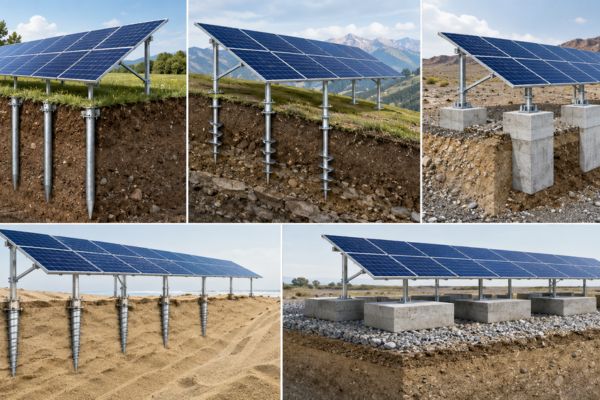
Main Ground Mounted Solar Structure Foundation Types
Several foundation systems are used in solar projects. The right option depends mainly on soil, structural load, terrain, and project requirements.
Driven Pile Foundation
A driven pile foundation is one of the most common foundation systems for large ground mounted solar plants.
Steel piles are pushed or driven directly into the ground using pile-driving equipment. The solar mounting structure is then connected to these piles.
Main Benefits
- Fast installation
- Less concrete work
- Suitable for large solar projects
- Lower civil work in suitable soil
- Good structural strength
- Easy installation across large areas
Best Applications
Driven piles are commonly used for:
- Utility-scale solar plants
- Solar parks
- Industrial solar projects
- Open agricultural land
- Flat or gently sloping land
- Large EPC projects
When Driven Piles May Not Be Suitable
They may become difficult to install when the ground contains:
- Large rocks
- Very hard rock layers
- Underground concrete
- Very shallow bedrock
- Heavy construction debris
Concrete Foundation
Concrete foundations are widely used when direct pile driving is difficult or when the project requires a strong permanent base.
A pit is excavated, reinforcement may be installed, and concrete is poured around the mounting post or anchor system.
Advantages of Concrete Foundations
- Strong and stable
- Suitable for difficult soil conditions
- Can support heavy structures
- Flexible foundation dimensions
- Useful where pile driving is not possible
Applications
Concrete foundations are suitable for:
- Rocky areas
- Loose soil
- Industrial sites
- Small and medium solar plants
- High-load solar structures
- Locations where soil strength is uncertain
Important Considerations
Concrete foundations usually require more:
- Excavation
- Labour
- Cement and reinforcement
- Curing time
- Water
- Site preparation
Ground Screw Foundation
Ground screws are large steel screws installed directly into the soil. They work in a similar way to a large screw entering wood.
A special machine rotates the ground screw into the soil. The solar structure can then be attached to the top connection.
Why Ground Screws Are Used
- Quick installation
- Minimal excavation
- Very little concrete
- Reduced site disturbance
- Can be removed if required
- Useful for uneven land
Common Applications
Ground screw foundations may be used for:
- Small solar farms
- Commercial solar projects
- Temporary solar installations
- Uneven sites
- Agricultural land
- Sites where concrete should be reduced
Ballasted Foundation
A ballasted foundation does not normally require deep penetration into the soil.
Instead, concrete blocks or heavy ballast units are placed on the ground. Their weight keeps the solar mounting structure stable.
Main Advantages
- Very little ground penetration
- Easy removal
- Lower underground disturbance
- Useful where digging is restricted
- Suitable for temporary projects
Applications
Ballasted structures can be considered for:
- Rocky surfaces
- Landfills
- Sites with underground services
- Temporary solar plants
- Locations where digging permission is limited
RCC Footing Foundation
RCC stands for Reinforced Cement Concrete.
In this type of foundation, steel reinforcement is placed inside a concrete footing. The solar structure column is connected using anchor bolts or embedded parts.
RCC foundations are generally stronger than simple concrete blocks and are useful where higher structural loads are expected.
Suitable Applications
- High wind zones
- Heavy solar structures
- Industrial installations
- Large module tables
- Weak soil
- Special engineering projects
The size and reinforcement of an RCC foundation should always be based on structural calculations.
Helical Pile Foundation
Helical piles have one or more steel plates shaped like screws near the bottom of the shaft. They are rotated into the soil instead of being hammered.
They can provide strong resistance against both downward load and upward wind force.
Benefits
- Strong pull-out resistance
- Fast installation
- Limited excavation
- Suitable for certain weak soils
- Can reduce concrete requirement
Best Uses
Helical piles can be useful in:
- Soft ground
- Expansive soil
- Sites requiring high uplift resistance
- Areas with difficult access
- Special solar foundation projects
Quick Comparison of Solar Foundation Types
| Foundation Type | Installation Speed | Concrete Requirement | Best Application |
|---|---|---|---|
| Driven Pile | Fast | Very Low | Large solar plants |
| Concrete Foundation | Medium | High | Difficult soil |
| Ground Screw | Fast | Very Low | Uneven or low-disturbance sites |
| Ballasted Foundation | Medium | High | No-ground-penetration sites |
| RCC Footing | Medium | High | Heavy-duty structures |
| Helical Pile | Fast | Low | Soft soil and uplift conditions |
Quick Comparison of Solar Foundation Types
Soil is one of the most important factors when selecting a foundation for a Ground Mounted Solar Structure.
The soil must safely support the structure throughout its service life.
Sandy Soil
Loose sandy soil may have lower holding strength. Deeper piles, larger foundations, or special foundation designs may be required.
Clay Soil
Clay can expand when wet and shrink when dry. Engineers must consider seasonal soil movement.
Black Cotton Soil
Black cotton soil can expand and contract significantly with moisture changes. Standard shallow foundations may not always be suitable.
Proper geotechnical investigation becomes very important.
Rocky Soil
Driven piles may face refusal in rocky ground. Concrete foundations, drilled piles, or special ground anchors may be more suitable.
Soft Soil
Soft ground may require deeper piles or foundations with larger load-transfer areas.
Ground Mounted Solar Structure Foundation for High Wind Areas
Wind creates two major forces on solar panels:
- Horizontal pressure
- Upward lifting force
Because solar modules are installed at an angle, strong wind can try to lift the complete structure from the ground.
Foundation design in high-wind areas should therefore consider:
- Wind speed
- Panel tilt angle
- Structure height
- Row spacing
- Foundation depth
- Soil resistance
- Pull-out capacity
- Steel section strength
- Bolt connections
A foundation that works well in a low-wind area may not be suitable for a high-wind location.
Why Pull Out Testing Is Important
Before installing thousands of piles, many large solar projects perform pull-out testing.
This test helps engineers understand how much force a pile can resist before it starts moving out of the ground.
The test can help verify:
- Required pile depth
- Soil holding strength
- Uplift resistance
- Foundation safety
- Possible pile design changes
Pull-out testing can also prevent expensive foundation changes after installation has already started.
How to Select the Right Solar Structure Foundation
Choosing the correct foundation should be based on engineering data instead of price alone.
Study the Site
Check:
- Land slope
- Soil condition
- Existing roads
- Drainage
- Underground services
- Nearby buildings
Conduct Soil Testing
A geotechnical investigation can provide useful information about:
- Soil layers
- Soil bearing capacity
- Rock depth
- Groundwater
- Soil density
Calculate Structural Loads
The design team should calculate:
- Dead load
- Wind load
- Module weight
- Structure weight
- Uplift force
Compare Foundation Options
Compare installation cost, time, equipment, soil suitability, and structural performance.
Conduct Trial Installation
For pile-based systems, trial piles can help confirm actual site conditions before full installation.
Applications of Ground Mounted Solar Structures
Ground mounted solar structures are used in many types of projects.
Common Foundation Mistakes to Avoid
Even a strong solar structure can face problems when the foundation is not planned correctly.
Avoid these common mistakes:
- Selecting foundations without soil testing
- Using the same pile depth across very different soil areas
- Ignoring wind uplift
- Poor pile alignment
- Installing foundations at incorrect levels
- Ignoring drainage conditions
- Using incorrect concrete mix
- Poor anchor bolt positioning
- Installing piles without trial testing
- Choosing foundation type only based on low cost
Foundation correction after module installation can be expensive. Proper planning at the beginning is much safer.
Why Foundation Accuracy Matters for Solar Panel Alignment
Foundation position directly affects the complete mounting structure.
If one foundation is too high, low, tilted, or out of position, several problems may appear:
- Structure members may not fit properly
- Module rows may become uneven
- Installation time may increase
- Bolts may require forced alignment
- Solar panels may not sit correctly
- Maintenance can become difficult
Accurate survey work and foundation installation help reduce these problems.
Maintenance of Ground Mounted Solar Foundations
Solar foundations normally need limited maintenance, but regular inspection is useful.
Check for:
- Loose bolts
- Corrosion
- Soil erosion
- Concrete cracking
- Foundation movement
- Flood damage
- Settlement
- Vegetation around structural posts
Extra inspection should be carried out after heavy rain, flooding, storms, or unusual wind events.
Role of a Ground Mounted Solar Structure Manufacturer
A reliable Ground Mounted Solar Structure Manufacturer should not only supply steel sections. The manufacturer should understand how the complete structure will interact with the foundation.
Important information normally includes:
- Module dimensions
- Module quantity
- Panel tilt
- Table configuration
- Site wind conditions
- Foundation type
- Ground clearance
- Row spacing
- Steel grade
- Corrosion protection
- Connection details
Coordination between the solar structure manufacturer, civil engineer, geotechnical consultant, and EPC contractor helps reduce installation problems.
Factors That Affect Solar Foundation Cost
The cheapest foundation type is not always the lowest-cost solution for the complete project.
Foundation cost can change based on:
- Soil type
- Required depth
- Steel quantity
- Concrete quantity
- Excavation
- Labour cost
- Installation equipment
- Site accessibility
- Rock condition
- Number of foundations
- Project location
- Wind-load requirement
For example, driven piles may reduce concrete work but could become expensive if pile refusal is common.
A proper site study helps identify the most practical option.
Factors That Affect Solar Foundation Cost
The cheapest foundation type is not always the lowest-cost solution for the complete project.
Foundation cost can change based on:
- Soil type
- Required depth
- Steel quantity
- Concrete quantity
- Excavation
- Labour cost
- Installation equipment
- Site accessibility
- Rock condition
- Number of foundations
- Project location
- Wind-load requirement
For example, driven piles may reduce concrete work but could become expensive if pile refusal is common.
A proper site study helps identify the most practical option.
Conclusion
The foundation is one of the most important parts of a Ground Mounted Solar Structure. Driven piles, concrete foundations, ground screws, ballasted foundations, RCC footings, and helical piles all have different advantages.
The correct choice depends on soil condition, terrain, wind load, solar structure design, project size, installation equipment, and budget.
Before finalising a foundation, project developers should complete proper site evaluation, soil testing, structural calculations, and trial installation where required. A carefully designed foundation helps improve structural stability, installation accuracy, and long-term solar plant performance.
Frequently Asked Questions
There is no single best foundation. Driven piles are commonly used for large projects, while concrete, ground screws, or other systems may be better for difficult soil.
No. Many ground-mounted solar projects use steel driven piles or ground screws without large concrete foundations.
Pile refusal happens when a pile cannot reach the required depth because it hits hard rock, dense soil, concrete, or another obstruction.
Soil testing helps engineers understand soil strength, soil layers, groundwater conditions, and the possible foundation depth.
Yes. However, special foundation systems such as concrete footings, drilled foundations, or ground anchors may be required.
A ballasted foundation uses heavy blocks, generally made from concrete, to hold the solar structure in place without deep ground penetration.