

Prevent Water Leakage in Rooftop Solar Installation
Rooftop solar panels help homes, offices, factories and commercial buildings use available roof space for power generation. However, poor installation can create holes, cracks and weak sealing points on the roof.
These problems may allow rainwater to enter the building. The leakage may not appear immediately. It often becomes visible during heavy rain or after the waterproofing layer becomes weak.
SSP India provides rooftop solar mounting structures that may be fixed directly to a rooftop or installed with additional rails. Its listed structures are made for domestic, commercial and industrial solar projects and can be customised according to project requirements.
Why Can Rooftop Solar Installation Cause Water Leakage?
Solar panels do not normally create leakage by themselves. Leakage usually develops because the roof surface or mounting work is not planned correctly.
Common causes include:
- Drilling in the wrong location
- Damaging an existing waterproofing layer
- Using unsuitable sealant
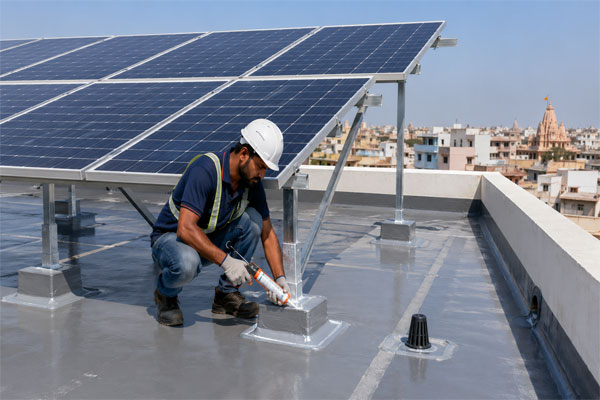
- Poor sealing around anchor bolts
- Cracks around mounting bases
- Loose or badly fitted base plates
- Blocking rainwater outlets
- Incorrect roof slope
- Water collecting around the structure
- Damaged tiles or roof sheets
- Corroded fasteners
- Unplanned cable openings
- No water test after installation
A small opening around one anchor bolt may allow water to move inside the concrete. The wet patch may later appear at another location on the ceiling.
For this reason, the visible leakage point may not always be directly below the solar structure.
Check the Roof Before Installing the Solar Structure
A proper roof inspection is the first step in preventing leakage.
Solar installation should not begin only because the roof looks dry on the installation day.
Check for Existing Leakage
Look for:
- Damp ceiling patches
- Peeling paint
- White salt-like marks
- Cracks on the terrace
- Wet areas near walls
- Leakage around pipes
- Damaged tile joints
- Water near drainage outlets
- Old waterproofing repairs
Existing leakage should be repaired before the solar structure is installed.
Covering the problem with solar panels will not solve it. It may make the damaged area more difficult to reach later.
Check the Waterproofing Layer
The inspection team should identify:
- Type of existing waterproofing
- Age of the waterproofing
- Cracks or bubbles
- Loose coating
- Damaged corners
- Weak joints
- Previous patchwork
- Areas where water remains after rain
A new waterproofing treatment may be required when the existing layer is damaged or near the end of its useful condition.
Check the Structural Strength
A qualified professional should check whether the roof can safely carry:
- Solar panels
- Mounting structures
- Rails and clamps
- Cable trays
- Maintenance workers
- Wind pressure
- Water tanks or other rooftop equipment
Waterproofing and structural strength are different issues. A dry roof may still be structurally weak, while a strong roof may still have leakage.
Select the Correct Solar Mounting Method
The mounting method should match the roof type, structural design and waterproofing condition.
Common methods include:
- Anchored mounting structure
- Rail-based mounting system
- Raised solar structure
- Ballasted mounting system
- Custom rooftop structure
- Direct rooftop fixing
SSP India states that its rooftop structures can be attached directly to the rooftop or used with additional rails to support solar-panel frames.
Anchored Solar Structure
An anchored structure is fixed to the roof using approved fasteners or anchor bolts.
It can provide strong support, but every penetration must be carefully planned and sealed.
Important checks include:
- Anchor location
- Concrete strength
- Drilling depth
- Waterproofing treatment
- Base-plate design
- Sealant compatibility
- Final water test
Ballasted Solar Structure
A ballasted structure uses weight to hold the system in position instead of creating many roof penetrations.
It may reduce drilling, but it is not automatically suitable for every roof.
The roof must be checked for:
- Additional weight
- Wind uplift
- Water drainage
- Movement
- Waterproofing protection
- Load distribution
A structural engineer should approve the system before installation.
Raised Solar Structure
A raised structure keeps the solar panels above the roof at a planned height.
It may provide space for:
- Roof cleaning
- Water drainage
- Maintenance access
- Cable routing
- Use of the terrace below
However, a taller structure may receive more wind pressure. It needs proper design and strong structural connections.
Common Leakage Problems and Solutions
| Problem | Possible Cause | Helpful Solution |
|---|---|---|
| Water around an anchor | Poor sealing | Remove weak material and reseal correctly |
| Leakage below a base plate | Water entering below the plate | Treat the full edge and fixing point |
| Damp patch near a cable entry | Open or low cable hole | Raise and reseal the entry |
| Water stays below panels | Drainage is blocked | Clear the route and improve access |
| Waterproof coating is scratched | Material dragged across roof | Repair coating and use protective pads |
| Cracks appear after drilling | Weak concrete or poor drilling | Inspect and repair the concrete |
| Leakage returns after rain | Only surface sealant was used | Check the full penetration depth |
| Drain outlet cannot be cleaned | Poor panel layout | Provide maintenance access |
| Sealant becomes loose | Wrong or incompatible material | Use an approved outdoor waterproofing system |
| Metal parts rust | Weak corrosion protection | Replace damaged parts and improve protection |
Why Choose SSP India?
Rooftop Structure Options
Its rooftop solar structures may use direct fixing or additional rails depending on project requirements.
Different Applications
The company lists rooftop structures for domestic, commercial and industrial solar installations.
Material Options
Its rooftop page states that the structures are manufactured using galvalume or pre-galvanised materials.
Customised Requirements
Structures may be customised according to customer and project requirements.
Frequently Asked Questions
Solar panels do not normally cause leakage directly. Leakage may develop because of poor drilling, damaged waterproofing, weak sealing or blocked drainage.
Yes, existing cracks, leakage and damaged waterproofing should be treated before installing the mounting structure.
Some roofs may support ballasted or non-penetrating systems, but their weight, wind resistance and structural suitability must be checked.
The holes and fixing areas should be cleaned, sealed and connected with the existing waterproofing system using compatible materials.
A general sealant may not be suitable for every roof. The selected product should match the concrete, metal and existing waterproofing.
The leakage should be found and repaired first. Solar panels should not be used to cover a damaged roof.
Blocked outlets cause standing water. This increases pressure on cracks, joints and weak waterproofing areas.
Yes. Poorly sealed cable openings can allow rainwater to enter the building.
A raised structure may provide easier roof access and drainage, but its base connections must still be properly sealed and structurally designed.
Conclusion
Water leakage during rooftop solar installation can be prevented through proper planning.
The process should start with roof inspection, crack repair and waterproofing checks. The mounting system should then be selected according to the roof type, structural strength and project location.
Every anchor, base plate and cable entry must be sealed properly. Drainage routes should remain open, and the waterproofing layer should be protected throughout the installation.
Do not depend only on a small amount of surface sealant. A reliable result requires correct drilling, compatible waterproofing materials, proper mounting and final testing.