

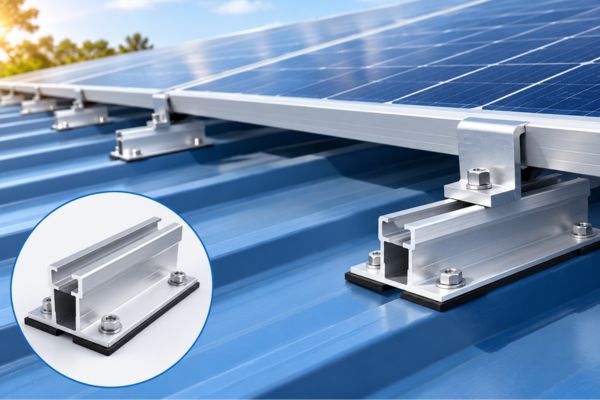
Short Mini Rails for Solar Panel Mounting on Metal Roofs
Short mini rails provide local support points for solar panels on compatible metal roofs. Instead of running continuous rails beneath an entire row, these systems use short rail sections at planned fixing positions. Module clamps connect the panel frames to the rails.
This arrangement can reduce the amount of rail material used and make components easier to handle on the roof. However, suitability depends on the roof profile, sheet thickness, fixing strength and project loads.
For solar installers, choosing the right mini rail starts with checking the roof and panel requirements together.
What Is a Short Mini Rail?
A short mini rail is a compact mounting section used to connect a solar module to a suitable roof attachment. The rail normally includes a channel or fixing arrangement for compatible module clamps.
Depending on the system, the rail may attach directly to an approved metal roof sheet using specified screws and sealing components. Other roof types may require a different mounting method.
For example, K2’s MiniRail MK2 is designed for specified trapezoidal metal roof applications. Its requirements should not be treated as specifications for every short mini rail available in the market.
How Do Short Mini Rails Hold Solar Panels?
Short mini rails form part of the connection between the module frame and the roof. The panel clamps grip the frame, while the rail and roof fasteners transfer forces into the approved supporting assembly.
Each connection has a separate role:
| Component | Main Function |
|---|---|
| Short mini rail | Provides a mounting point for compatible clamps |
| Mid clamp | Secures adjacent module frames where specified |
| End clamp | Secures the outer module frame |
| Roof fastener | Connects the rail to the approved roof attachment |
| Sealing component | Helps seal roof penetrations when correctly installed |
The complete assembly must work together. A strong rail cannot compensate for an unsuitable screw, weak roof sheet or incorrectly positioned clamp.
Why Use Short Rails Instead of Continuous Rails?
Easier Movement Around the Roof
Compact rail sections are easier to carry through access points and position near the work area. This can help installers manage materials on roofs with limited working space.
Good material planning still matters. Loose components should be secured, and roof access routes should remain clear during installation.
Less Continuous Rail Material
A mini rail layout uses separate support sections rather than continuous profiles. On a compatible project, this can reduce rail quantity and storage space.
The final saving depends on the number of support points, rail dimensions, fasteners and accessories required. Compare the complete mounting bill of materials before deciding which system costs less.
Support at Planned Clamp Positions
Short rails allow mounting points to be placed according to an approved layout. These positions must match both the available roof fixing locations and the module manufacturer’s permitted clamping zones.
A convenient roof position alone is not enough. The panel frame must also be supported where its manufacturer allows. K2’s assembly guidance specifically requires installers to follow module clamping recommendations.
Which Metal Roof Details Need Checking?
Metal roofs differ in shape, thickness and condition. A rail that fits one sheet profile may not seat correctly on another.
Before selecting a short mini rail, check:
- Roof profile: Confirm whether the sheet is trapezoidal, corrugated or standing seam.
- Crest dimensions: Measure the raised section where the proposed attachment will sit.
- Sheet thickness and grade: Compare these with the mounting system’s documented limits.
- Roof condition: Look for corrosion, loose fixings, damaged sheets and previous leaks.
- Supporting structure: Confirm that the roof assembly can carry the proposed installation.
- Roof manufacturer requirements: Check restrictions affecting attachments and warranty.
Standing seam roofs, for example, may use approved seam clamps rather than the direct screw attachment used by certain trapezoidal roof systems. Select the mounting method for the actual roof.
Why Wind Loads Affect Mini Rail Selection
Wind can create uplift forces that pull panels away from the roof. These forces pass through the clamps, rails, screws and roof assembly.
The mounting layout must account for the building location, height, roof geometry and panel arrangement. A layout used on one warehouse should not automatically be copied onto another building.
Projects in Ahmedabad, Surat, Rajkot or coastal Gujarat may have different site conditions. Use the project’s structural assessment to determine fixing positions and quantities.
Buying a thicker rail alone does not establish the capacity of the complete installation.
How Are Roof Penetrations Sealed?
Where a mini rail system uses screws through the roof sheet, the sealing arrangement needs careful attention. Use the specified washers, pads or gaskets and follow the installation instructions.
The fixing surface should be suitable for the seal to sit correctly. Incorrect screw installation can damage a sealing washer or leave an incomplete seal.
Avoid adding unapproved sealants as a substitute for the designed sealing method. Also check that rails, cables and accessories do not obstruct roof drainage.
Common Short Mini Rail Installation Mistakes
Choosing Rails Before Measuring the Roof
Ordering from a product photograph can lead to a poor fit. Share roof measurements and profile drawings with the supplier before confirming the rail.
Using Incompatible Clamps
Check module frame height, clamp engagement and rail channel compatibility. Components that appear to fit may still fall outside the approved system.
Guessing Fastener Tightness
Use the specified installation settings and tools. Excessive tightening can damage components, while insufficient tightening can leave connections insecure.
Ignoring Cable Management
Keep cables supported and clear of sharp metal edges, drainage paths and surfaces where movement could cause wear.
Assuming Rails Provide Electrical Bonding
Electrical bonding and earthing need a planned solution. Confirm the required bonding components and continuity checks for the selected mounting system.
What Should You Ask a Short Mini Rail Manufacturer?
When comparing a Short Mini Rail Manufacturer in Ahmedabad, Gujarat or elsewhere in India, request information that helps verify project suitability.
Ask for:
- A dimensioned rail drawing and material specification.
- Compatible roof profiles and minimum roof requirements.
- Approved screws, clamps and sealing accessories.
- Installation instructions and tightening requirements.
- Load data with its test conditions and limitations.
- Guidance on corrosion compatibility.
- Available lengths, packing quantities and delivery terms.
Provide the supplier with module dimensions, frame height, roof details and the proposed layout. These details make a quotation more useful than a price based only on rail quantity.
Discuss Your Solar Mounting Requirements With SSP India
Short mini rails can be a practical option when the roof, module and mounting assembly are compatible. Selection should follow the project requirements and documented installation limits.
Visit SSP India to enquire about short mini rails for your solar project. Share your roof profile, panel details and required quantity, and request the matching technical specifications before ordering.
Frequently Asked Questions
No. Compatibility depends on the roof profile, sheet properties, mounting method and structural assessment.
They may be suitable when the system supports the panel dimensions, approved clamp zones and calculated project loads. Panel size alone does not confirm compatibility.
No. Compare the full cost of rails, clamps, screws, seals, design work and labour for the specific project.
Some systems support both orientations. Confirm the permitted arrangement with the rail and module manufacturers.
Provide the roof profile, sheet thickness and material, module dimensions, frame height, layout and project load requirements.
Conclusion
Allen key bolts are useful in solar panel installation because they offer practical tool access and fit many mounting assemblies designed for socket fasteners. However, secure installation depends on choosing the correct bolt and using it properly.
Check the length, thread, material, strength, and tightening instructions before installation. For product enquiries in Ahmedabad, Gujarat, or elsewhere in India, share your solar mounting requirements with SSP India.